Nancy Chu
@chuthuyquynh38early
Project
Myspecmyspec.dev
Stop prompting, start architecting. MySpec helps you define what to build before AI writes a single line of code.
A lot has been changing at MySpec lately 👀
And we’re starting with the first thing you see: our landing page.
New look, clearer story, and a much better reflection of where MySpec is heading. This is only the beginning, there’s a lot more we’ve been working on behind the scenes.
Check out the new landing page right now: myspec.dev
More updates coming soon 👀
"Looks good" is becoming a dangerous approval process.
AI is getting very good at producing outputs that look complete. The structure is clean, the reasoning sounds convincing, and everything seems ready to move forward.
But polished doesn't always mean correct.
A solution can look perfectly reasonable while still missing a requirement, overlooking an edge case, or making an assumption that doesn't match what you originally intended. And as AI generates more of the work, simply reading through everything and thinking "looks good" becomes less reliable.
That's why MySpec doesn't stop at generation.
Before you approve a stage, MySpec runs an AI Review against the context and requirements you've already defined. Instead of giving you a generic pass or fail, it surfaces specific findings and separates them by priority.
Must Fix highlights issues that should be addressed before moving forward. Recommendations show areas that could make the solution stronger. Each finding also receives a score and a clear suggestion, so you can quickly understand what needs attention without reviewing the entire output from scratch.
Most importantly, MySpec doesn't make the final decision for you. You can review the feedback, decide what matters, make changes, and approve the stage when you're comfortable moving forward.
For founders, this means you don't need to blindly trust a polished AI output. For developers, it creates a clearer checkpoint before questionable assumptions make their way further into implementation. And for teams, it gives everyone a more structured way to understand why something is ready to proceed.
AI can generate fast. The goal isn't to slow it down.
It's to make sure "looks good" actually means "ready to move forward."
If you're building with AI and want more control over what happens before implementation, we'd love for you to try MySpec and share your feedback.
AI coding is getting cheaper. So why aren't we shipping faster?
Atlassian recently shared an interesting finding: AI usage among engineering teams increased by 65%, but overall developer velocity didn't. Coding agents can generate in minutes what once took hours, yet writing code is only one part of shipping software.
The hidden cost often comes later: rework. When requirements are vague or constraints are missing, AI can make assumptions and start implementing them at speed. What looks like faster development can quickly become another cycle of reviewing, correcting, and regenerating.
That's why the next big optimisation in AI development may happen before coding starts.
It's also the thinking behind Spec-Driven Development. At MySpec, we help turn an initial idea into structured requirements, solution design, and implementation tasks before an AI coding agent starts building. The goal isn't to slow AI down, but to give it clearer context so there's less to undo later.
AI-generated code will keep getting faster. But maybe the real bottleneck isn't coding anymore. It's clarity.
For those building with AI coding agents, where do you spend more time today: generating code or fixing what gets generated?
Source: atlassian.com/blog/company-news/ai-sdlc
MySpec is during beta, feel free to try: myspec.dev
How has your experience with Notion changed over time?
We still use Notion almost every day.
It's where ideas start, meeting notes live, and product discussions happen. Notion itself even recommends it as a central place for product specs, project overviews, and engineering documentation.
But I'm curious...
Have you ever opened a Notion page that you wrote six months ago and thought:
"Why did we make this decision?"
Or even:
"Is this still the latest version?"
It's not because Notion is missing features.
It's because software projects evolve much faster than documents do.
While building MySpec, we noticed the same thing. A feature doesn't just need documentation. It needs a process that keeps asking questions, captures decisions, tracks revisions, and lets the team refine requirements before implementation.
That's one of the reasons we built MySpec around an AI-guided interview instead of starting with a blank page.
Rather than expecting you to remember every edge case, constraint, or user scenario yourself, MySpec helps uncover them through structured conversations, then turns those discussions into implementation-ready specifications that can continue evolving with your project.
We're not trying to replace Notion.
We just found that, when it comes to building software, a blank document isn't always the best place to start.
I'm curious how other founders and developers handle this.
Do your product ideas still live comfortably in Notion, or have you found yourself needing something more structured as your projects grow?
Check it out: myspec.dev
The simplest way to avoid version confusion during product reviews
As your product grows, so does the number of people involved. Co-founders, developers, designers, clients, advisors, even investors all need to review your work at different stages.
The problem is that collaboration quickly becomes messy when everyone is looking at different versions of the same document. Feedback gets scattered, decisions become harder to track, and teams can easily end up discussing an outdated specification. That's one of the reasons many organizations invest in maintaining a single source of truth, ensuring everyone is working from the same, trusted information.
That's why we introduced Public Links in MySpec.
Instead of sharing a live document that keeps changing, MySpec creates a snapshot of your specification at the moment you decide to share it. Everyone reviewing the link sees exactly the same version, even if your team continues working internally. You can also set an expiry date, revoke access at any time, and generate a new snapshot whenever you're ready for another round of feedback.
Whether you're asking for client approval, sharing progress with your team, handing work over to developers, or collecting feedback before the next release, everyone stays aligned around the same specification.
We believe better collaboration doesn't come from sharing more documents. It comes from sharing the right version, at the right time, with the right people.
🌐 Website: myspec.dev
📖 Read more about Public Links: blog.myspec.dev/posts/introducing-public-links-…
Another week, another update!! We think founders will find this one especially useful.
One thing we've learned from building MySpec is that great product planning isn't just about generating better specifications. It's about making the entire workflow easier, from planning and reviews to collaboration.
🔗 Public Links
One of the most requested features is finally here. You can now create a public link to a frozen snapshot of your specifications and share it with anyone, no account required. It's perfect for client reviews, stakeholder approvals, technical handoffs, or simply keeping everyone aligned on the exact same version. You can also set an expiry date, revoke access at any time, or generate a new snapshot whenever your specs evolve.
🤖 More AI models
Different models excel at different tasks, so we've expanded the lineup. MySpec now supports Claude Opus 5, Claude Sonnet 5, GPT-5.6, Gemini 2.5 Flash, and Gemini 2.5 Flash-Lite. Whether you're brainstorming a new product, analysing an existing codebase, or refining requirements, you can choose the model that best fits the job instead of relying on a single one.
🤝 Better collaboration
We also improved the everyday workflow. Visitors can now download an entire shared specification as a ZIP file, folders are expanded by default so it's easier to explore projects, and the sharing experience has been simplified to make collaboration feel much more natural for both teams and clients.
We hope these updates remove a little more friction from the product building process. As always, we'd love to hear your thoughts.
More details:
blog.myspec.dev/posts/introducing-public-links-…
Our website: myspec.dev
Looking for one place to work with all your codebases?
Most founders don't spend their time building brand new products. They spend it improving existing ones. Adding features, fixing bugs, refactoring legacy code, or trying to understand a codebase they didn't write. The biggest challenge usually isn't writing the code, it's understanding what already exists before making changes.
That's why we built the Brownfield workflow in MySpec. It helps you analyse your existing codebase, generate structured requirements, review proposed changes, and create implementation-ready specifications before development starts. Instead of beginning every feature with another AI prompt, you begin with a clear understanding of the system.
If you're working with existing products every day, Brownfield might be worth exploring.
Our website: myspec.dev
Your codebase isn't just code anymore. It's your product's memory.
Every release leaves something behind.
Business rules, ddge cases, product decisions, customer feedback, years of iteration.
That's why an existing codebase is far more valuable than the lines of code themselves. It tells the story of how your product evolved.
The challenge is making sure every new feature respects that story instead of accidentally breaking it.
That's one of the reasons we built Brownfield.
By starting with your existing project, Brownfield helps you understand what already exists before planning what's next. The result is clearer specifications, more confident decisions, and fewer surprises during implementation.
If you're building on top of an existing product, we'd love for you to explore Brownfield during our Open Beta and hear what you think.
🌐 Website: myspec.dev
💬 Feedback Form: docs.google.com/forms/d/e/1FAIpQLSdJv_x7g7oy1AR…
We hear you out, founders!
Launching your first version is a huge milestone.
But growing an existing product is a completely different challenge.
Every new feature, every improvement, every refactor starts with the same question: "How will this change affect everything we've already built?"
That's exactly why we introduced Brownfield in MySpec.
Instead of asking you to start from scratch, Brownfield starts from your existing project. It helps you understand the requested change, guides you through AI-powered change planning, lets you review every revision before it's applied, and generates implementation-ready specifications that your team or AI coding assistants can build from with confidence.
Because improving an existing product shouldn't mean rebuilding the context every single time.
If you've already shipped your first version, we hope this update makes every version after that a little easier.
We'd love to hear how Brownfield fits into your workflow.
🌐 Website: myspec.dev
📖 Read more about Brownfield: blog.myspec.dev/posts/introducing-the-brownfiel…
💬 Feedback Form: docs.google.com/forms/d/e/1FAIpQLSdJv_x7g7oy1AR…
Dear founders and builders on Strivle, this update is for you. 🚀
Over the past few months, many of you have shared your experiences, suggestions, and honest feedback with us. Every conversation has helped shape the next version of MySpec, and today, we're excited to finally share it with you.
Here's a glimpse of what's new:
✨ Support for both Greenfield (new ideas) and Brownfield (existing codebases)
🤖 A smarter AI-guided discovery process that asks better questions before development begins
📝 More structured proposals, requirements, architecture, and implementation plans
🔄 A review workflow so you can refine and approve every stage before moving forward
⚡ Better integrations with AI coding tools like Claude Code, Cursor, Lovable, Bolt, Replit, and more
...and that's just part of this release. We've shipped many more improvements across the entire workflow, all designed to make planning, collaboration, and building with AI much smoother.
If these updates sound like something you've been looking for, we'd be honoured to have you explore the new version of MySpec during our Open Beta. We'd love to hear your thoughts and discover which new feature becomes your favourite.
📖 Read more: blog.myspec.dev/posts/introducing-the-next-gene…
🌐 Website: myspec.dev
💬 Feedback Form: docs.google.com/forms/d/e/1FAIpQLSdJv_x7g7oy1AR…
Long time no TAAFT update 👋
A few weeks ago, we were celebrating breaking into the Top 100.
Today, MySpec is sitting at #14. 🚀
It's been an incredible journey, and we're getting closer to the Top 10 than we ever imagined.
If you're already on There's An AI For That and believe in what we're building, we'd really appreciate your support with an upvote. Every vote genuinely helps us reach more founders and builders who might benefit from MySpec.
And if you have a project listed there too, drop your link below! I'd be more than happy to check it out, leave an upvote, and support you back.
Let's help each other grow. 💙
TAAFT: theresanaiforthat.com/ai/myspec/
Website: myspec.dev
AI isn't slowing us down anymore. Everything around AI is.
I came across an interesting report shared by TechRadar today.
One statistic immediately caught my attention:
79% of organisations say AI has improved individual developer productivity, but software delivery hasn't accelerated at the same pace.
GitLab calls this the "AI Paradox."
I don't think the problem is AI.
Developers are writing code faster. The challenge is that products are still built by teams, not individuals. Requirements change. Product decisions evolve. Context gets lost. Reviews take longer. AI can generate code in seconds, but it can't magically align everyone on what should be built.
To me, this report reinforces one thing:
The next competitive advantage won't come from generating more code. It'll come from creating better clarity before the code is written.
That's exactly the direction we're building toward with MySpec.
What do you think? Have you experienced this "AI Paradox" in your own workflow?
Feel free to try : myspec.dev
Founders, what's usually slowing your product down the most?
Building0%
Finding users100%
Funding0%
Distribution0%
4 votesClosed
Calling all founders on PeerPush, we'd love your support. 🚀
As an early-stage startup, every new platform is another chance to get closer to the founders and builders we're creating this for. If you've had a chance to try MySpec, we'd really appreciate an upvote. And if you've used it before, a short comment or honest review would mean even more. It helps other founders understand what we're building, and it helps us improve the product.
PeerPush: peerpush.com/p/myspec
If you've launched on PeerPush too, drop your link below. I'd be happy to check it out, leave an upvote, and support you back. Looking forward to discovering what everyone is building. 🙌
And don't forget to give MySpec a try while we're in Open Beta. It's completely free to use.
Website: myspec.dev
Have you ever opened a new Notion page to write a PRD... then spent more time thinking about what to write than actually writing?
I think a lot of founders have experienced this at least once. Not because Notion isn't great, but because planning a product is often much harder than documenting it. At that stage, requirements are still incomplete, user flows are still evolving, edge cases haven't been considered yet, and there are always assumptions hiding somewhere in the process.
That's exactly where we felt something was missing.
Instead of starting with a blank page, MySpec starts with questions. It guides founders through product discovery, helps uncover missing requirements, challenges assumptions, and gradually turns rough ideas into a structured specification. By the time you sit down to document everything, you already have a much clearer picture of what you're actually building.
For us, product planning and documentation aren't the same step. The clearer the thinking before you write, the better everything that comes after.
We're currently in Open Beta and free to try. If you've ever found yourself staring at a blank PRD, wondering where to begin, we'd love to hear what you think.
Website: myspec.dev
Seeing is always better than explaining.
We genuinely believe that no amount of words can fully explain how MySpec helps founders and builders throughout the product development journey. So instead of trying to describe it, here's a look at the complete MySpec workflow in action.
Starting from a rough idea, you'll see how MySpec guides the discovery process, uncovers missing requirements, structures user flows, designs the system architecture, and produces a build ready specification that both your team and AI coding tools can work from.
If you've been wondering where MySpec fits into your workflow, I hope this gives you a much clearer picture.
We're currently in Open Beta and free to try. If anything stands out while you're watching, we'd genuinely love to hear your thoughts.
Website: myspec.dev
🎥 Watch the full workflow: youtu.be/m83rnmqhcQU?si=nKoOW_Hjqbt80hU9
Still trying to get a little closer to the people we're building for.
I don't know if it's just me, but lately Strivle feels a little quieter than it used to. It's kind of sad because when I first joined, I genuinely believed it could become a place where founders connected, shared what they were building, exchanged ideas, and learned from each other.
I'll definitely keep showing up here. I've met some great founders and received thoughtful feedback along the way. At the same time, I also want to explore more places where MySpec can reach builders who might actually need it.
Today, that place is TinyLaunch. 🚀
If you have a minute, I'd really appreciate your support with an upvote. And if you've already tried MySpec, a short comment or an honest review would mean even more. Every bit of feedback helps us build a better product for founders.
TinyLaunch: tinylaunch.com/launch/15262
Website: myspec.dev
Wishing every founder who made it this far a productive day, and I hope you're one step closer to the people you're building for. 💙
Cursor Rules can tell AI how to code. But who tells AI what to build?
Cursor Rules are great at helping AI follow your coding standards, project structure, and development preferences. They make code generation more consistent and predictable.
But they assume one thing: you've already figured out exactly what you're building.
As founders, that's often the hardest part. We know the problem we want to solve, but not necessarily every requirement, user flow, edge case, or product decision that should come before development. No matter how well you write your Cursor Rules, AI can only build from the context you provide.
The quality of your code doesn't start with Cursor. It starts with the clarity behind your product decisions. That's exactly where MySpec fits, helping founders turn rough ideas into clear specifications before AI writes the first line of code.
Cursor helps you build faster. MySpec helps you build with confidence.
If that workflow resonates with you, we'd love for you to try MySpec during our Open Beta
Website: myspec.dev
Feedback Form: docs.google.com/forms/d/e/1FAIpQLSdJv_x7g7oy1AR…
Claude Code can build your product. But can it tell you what your product is missing, Founders?
We've been using Claude Code ourselves, and it's one of the most impressive AI coding tools available today. It can turn your ideas into working software incredibly fast. But we've learned that the quality of the final product doesn't just depend on the AI. It depends on the clarity of the instructions you give it.
As founders, we often know the problem we want to solve, but not necessarily every requirement, edge case, user flow, or product decision that should come before development. Claude Code isn't designed to figure those things out for you. It's designed to implement what you've already decided.
That's where MySpec comes in. Before you start building, MySpec helps you validate your idea, uncover missing requirements, challenge assumptions, and turn rough thoughts into a structured specification. The result isn't just better documentation. It's better context for Claude Code, leading to better software from the very first prompt.
We don't think MySpec replaces Claude Code. We think every founder should use MySpec before opening it.
If that sounds like a workflow you'd like to try! MySpec is currently in Open Beta and free to use.
Website: myspec.dev
Working with a team? MySpec should be one of your teammates.
As your project grows, so does the number of decisions your team has to make. A founder updates the product vision, a PM refines the requirements, a designer adjusts the user flow, and a developer starts implementing. It doesn't take long before everyone is working from a slightly different understanding of the same feature.
That's why we're building Collaboration into MySpec.
Our goal isn't simply to let people work together. It's to give every teammate a shared source of truth where ideas can be discussed, requirements refined, assumptions challenged, and product decisions aligned before development begins. Because the best teams aren't the ones that communicate the most. They're the ones building from the same understanding.
If this is how you want your team to work, start by trying MySpec yourself during our Open Beta. We'd love to hear your feedback as we continue building the best experience for teams.
Website: myspec.dev
Feedback Form: docs.google.com/forms/d/e/1FAIpQLSfiwMWMqFgUUVX…
I've seen a lot of founders here looking for more ways to get their products in front of users, so I thought I'd share a few launch platforms that have actually been helpful for us. If you're building an AI or tech product, hopefully this saves you some time.
🏆 There's An AI For That - 9/10
Our favourite so far for AI products. It brought us real users, quality feedback, and the highest level of engagement compared to other launch platforms.
Product Hunt - 7/10
Still the biggest and most trusted product launch community. The audience is huge and very active, but if you're a solo founder relying mainly on organic reach, don't expect instant traction. A successful launch usually depends on preparation, community support, and building momentum before launch day.
DevHunt - 7/10
A great option for developer tools and technical products. The audience is smaller than Product Hunt, but much more targeted.
Tiny Launch 8/10
Very straightforward submission process and a nice way to get additional exposure. If you're planning to use the free option, submit as early as possible because the queue can take a while.
Uneed - 7/10
Another platform worth adding to your launch checklist. The free queue is long, but if you're planning ahead, it's an easy way to gain extra visibility without spending money.
One thing I've learned is that no single platform will bring all your users. Different platforms attract different audiences, so it's worth experimenting instead of putting all your effort into one launch. Also, don't ignore the free launch options. They usually cost more patience than money, and that's often a good trade for early-stage founders.
If you've found another platform that worked well for your product, I'd love to hear about it.
Have you ever looked at your own product through the eyes of a first-time user?
I had that moment with MySpec.
The first time I opened our landing page, my honest reaction was, "This looks powerful... but am I actually the right person to use it?" There was so much happening that I almost convinced myself it wasn't built for someone like me. Then I decided to stop looking at it as part of the team and started using it like "a first-time founder" with nothing more than an idea.The experience was completely different. Instead of staring at a blank page wondering where to start, MySpec guided me through the questions I didn't even know I should be asking. It helped turn a rough idea into clear requirements, an architecture, and an implementation plan. It even suggested tools like Lovable, Bolt, and Replit so I could continue the journey and turn those specifications into a fully functional product.
What surprised me most was realising that the biggest barrier wasn't the product itself. It was my first impression of the product!
That experience reminded me of something I think every founder should do. Stop looking at your product as the person who built it. Try experiencing it as someone who's seeing it for the very first time.
You might be surprised by what you discover.🤩
The first version of your product is built by your team. The second version is shaped by your users.
After launch, everything changes. Every conversation gives you a different direction. One user asks for a new feature, another points out a confusing workflow, while someone else uncovers a product issue you never anticipated. Suddenly, you're surrounded by feedback, but it's no longer obvious what deserves your attention first.
The challenge isn't collecting feedback. It's turning scattered conversations into clear product decisions. Which requests should become features? What requirements are still missing? Which edge cases haven't been considered? What impact will one change have on the rest of your product?
That's why we built MySpec. Instead of treating feedback as an endless backlog, MySpec helps founders turn ideas into structured requirements, uncover hidden gaps, evaluate implementation impact, and create a clear implementation plan before development begins. Because after launch, building the next version of your product shouldn't feel like guesswork.
We're currently in Open Beta, feel free to try! If you're building your next release, we'd love for you to experience MySpec and hear your honest feedback as we continue improving it together.
Website: myspec.dev
Feedback Form:docs.google.com/forms/d/e/1FAIpQLSfiwMWMqFgUUVX…
AI writes 180% more code. So why aren't we shipping 180% more software?
A recent MIT study, covered by Forbes, found that AI coding agents increased the amount of code developers write by around 180%, yet the amount of software actually shipped increased by only about 30%.
That statistic made us rethink where the real bottleneck is.
As founders and builders, we spend a lot of time choosing models, learning prompt engineering, and trying to generate code faster. But building a successful product has never been just about writing code. It starts with understanding the problem, defining clear requirements, challenging assumptions, aligning everyone around the same vision, and making the right product decisions before development begins.
That's exactly the mindset we've been building MySpec around from day one. AI can dramatically accelerate execution, but it still depends on the quality of the thinking that comes before it.
Curious to hear what other founders and builders think. If code is no longer the biggest bottleneck, what is?
Do rankings really matter to builders and founders? I think they do, but probably not in the way most people imagine.
Seeing MySpec move from outside the top 1,000 to the top 100 isn't something we consider a success. To us, it's a sign that we're slowly reaching more people who share the same approach to building software.
Since day one, MySpec has been built around a simple idea. Great software doesn't come from writing better prompts. It comes from asking better questions, defining clearer requirements, challenging assumptions, and making better product decisions before development begins.
To be honest, building MySpec wasn't the hardest part. Helping people understand that mindset has been. In a world where AI can generate code in seconds, it's easy to believe that better prompts are the answer to everything. We believe the real advantage comes from having clarity before you ever ask AI to write a single line of code.
That's why this milestone means so much to us. It tells us that more founders, developers, and builders are beginning to resonate with this way of thinking.
I also believe this is a mindset every founder should embrace. AI will continue making software development faster, but speed alone has never built great products. The founders who win won't just be the ones who build the fastest. They'll be the ones who make the best product decisions.
We're still in Open Beta, and we're improving MySpec every week with feedback from the community. If this way of thinking resonates with you, we'd love for you to give MySpec a try and tell us what you think.
Website: myspec.dev
Feedback Form: docs.google.com/forms/d/e/1FAIpQLSfiwMWMqFgUUVX…
I think most founders will agree with this: building a product is one challenge, but getting it in front of the right people is a completely different one.
When we started building MySpec, we spent countless hours refining workflows, improving the user experience, and making sure the product solved a real problem. We thought that once we had something valuable, people would naturally find it.
Reality turned out to be very different.
Every conversation with a founder has taught us something we couldn't have learned on our own. Some assumptions were wrong. Some features mattered far less than we expected, while others became much more important because of real user feedback. Those conversations have shaped MySpec just as much as the code behind it.
That's also why we believe building shouldn't stop at shipping. Every product deserves to be challenged, refined, and improved before the next release, and that's exactly the mindset we're trying to bring into MySpec.
If you're also building something, I'd love to know what has been harder for you so far: building the product, or finding the people who truly need it?
Website: myspec.dev
Feedback Form: docs.google.com/forms/d/e/1FAIpQLSfiwMWMqFgUUVX…
One of the most expensive mistakes in software isn't bad code. It's building before everyone is clear on what should actually be built.
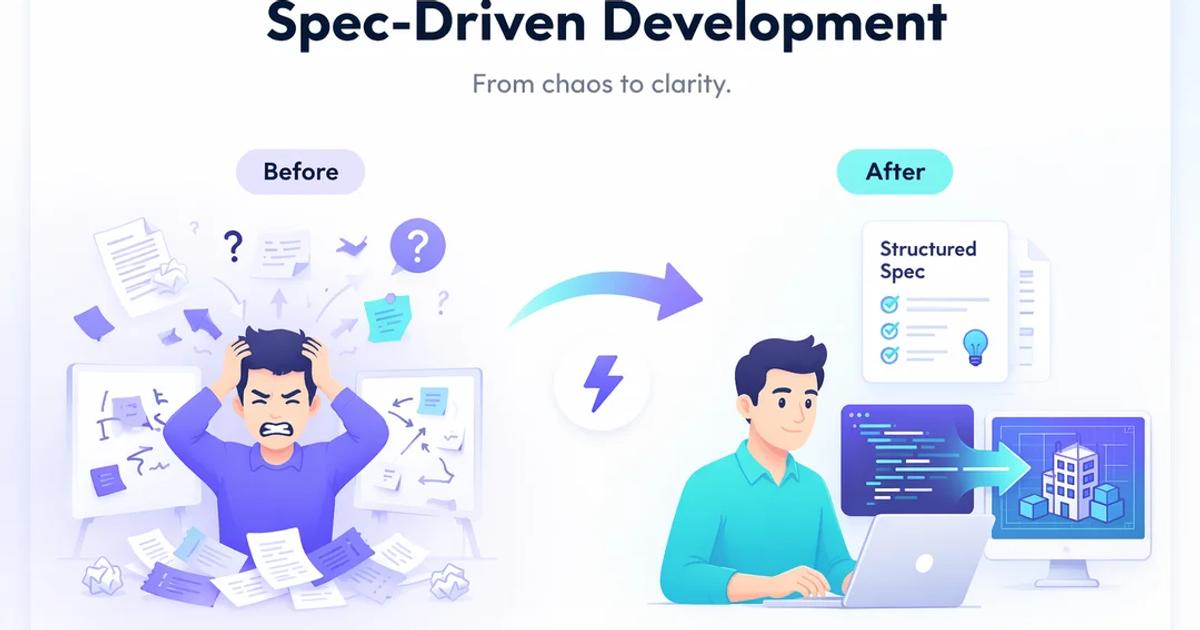
That's the idea behind Spec-Driven Development: turning assumptions into requirements, questions into decisions, and ideas into a clear plan before development begins.
We wrote a short article explaining why this approach matters more than ever in the age of AI.
Blog: blog.myspec.dev/posts/spec-driven-development-b…
Website: myspec.dev
Feedback form: docs.google.com/forms/d/e/1FAIpQLSfiwMWMqFgUUVX…
MySpec Blog
Spec-Driven Development: Building Software with Clarity Before Code | MySpec.dev
Spec-Driven Development is an approach where software implementation starts from a clear, structured specification rather than vague ideas, scattered tickets, or incomplete conversations.
You already have a product. What's next?
In today's world, products evolve faster than ever. What makes your product unique today could become a standard feature tomorrow, or worse, a small feature inside someone else's product.
That's why shipping isn't the finish line. The real challenge is continuously improving, refining, and strengthening your product so it remains valuable, relevant, and difficult to replace.
But turning ideas for improvement into reality isn't always straightforward. Which feature should come next? What requirements are missing? What edge cases haven't been considered? What impact will this change have on the rest of the product?
With MySpec, product improvements don't stay as ideas or notes in a backlog. They become structured requirements, implementation plans, architecture decisions, and actionable recommendations that help teams move forward with greater clarity and confidence.
The result isn't just a better plan. It's a clearer path toward building a product that keeps getting better over time.
If you're currently exploring new ideas, planning your next feature, or figuring out how to turn your vision into a better product, we at MySpec hope to help you shape those ideas into clear plans and bring them closer to reality.
Website: myspec.dev
Feedback Form: docs.google.com/forms/d/e/1FAIpQLSfiwMWMqFgUUVX…
We just reached #2 in the Technical Specifications category on TAAFT ❤️
Honestly, what excites me more than the ranking is seeing how many founders share the same problem: they know what they want to build, but aren't always sure what's missing before development begins.
That's exactly the problem we're trying to solve with MySpec.
Still early. Still improving and still collecting feedback from founders every day.
If you're building something, I'd love to know whether this resonates with you.
Website: myspec.dev
Feedback Form: docs.google.com/forms/d/e/1FAIpQLSfiwMWMqFgUUVX…
Founders, do you have a great idea but aren't sure where to start?
Not because you can't build it, but because there are still too many unanswered questions. Which features should come first? What requirements are missing? Which edge cases haven't been considered? What assumptions could become expensive mistakes later?
Many founders don't struggle because they can't build. They struggle because important decisions aren't clear before development begins.
MySpec brings those answers together before development begins.
With MySpec, founders can transform rough ideas into structured specifications, uncover missing requirements and edge cases, receive architecture and implementation guidance, and get actionable recommendations before investing significant time and resources into development.
Instead of guessing what might be missing, you gain a clearer path forward and a stronger foundation for both your team and AI coding tools.
The screenshot below shows a real example of how MySpec reviews specifications, identifies potential gaps, and provides recommendations before development begins.
Rather than taking our word for it, we'd invite you to try it yourself. MySpec is currently free during Open Beta, and we'd genuinely appreciate any feedback, suggestions, or criticism from fellow founders and builders.
Website: myspec.dev
Feedback Form: docs.google.com/forms/d/e/1FAIpQLSfiwMWMqFgUUVX…
Founders, indie hackers, developers, and operators..., I believe MySpec is built for us.
Have you ever had to re-explain your product every time you added a new feature? Or discovered missing requirements and logic gaps after development had already started?
We realised the problem often isn't the code. It's the lack of clarity before the code.
That's why we built MySpec.
MySpec helps turn rough ideas into structured requirements, architecture, and implementation plans before development begins, giving both humans and AI a clear source of truth.
It's currently free to try during Open Beta, and we'd love your feedback as we continue improving the product.
It's definitely a win for us if MySpec helps you avoid even one costly mistake before development begins!
Website: myspec.dev
Feedback Form: docs.google.com/forms/d/e/1FAIpQLSfiwMWMqFgUUVX…
0:00 / 0:00