Griffin Krum
@jdintelligencesaas
Project
JD Intelligence APIjdintelligence.dev
A job description API built to parse, score, enrich, and classify job descriptions with a single call.
Shipped: bulk JD generation for HR teams managing 50+ open reqs at once.
One API call, structured output for every role — no more copy-pasting templates and tweaking by hand. Built for enterprise HR.
The trust challenge you raised is spot on — it's the main friction in enterprise sales cycles for this space. What's helped us is that JD Intelligence API sits on the infrastructure side rather than the content generation side. We're parsing, normalizing, and structuring job descriptions teams already have — not generating new ones under their brand.
That distinction matters a lot with procurement: 'our AI generates your content' triggers heavy scrutiny. 'Our API structures your existing JD data' is a much easier conversation to have. The evaluation shifts from 'do we trust AI-written postings?' to 'can this reliably extract structured skills/requirements data from our library?' — and the latter has a clear ROI case.
I help B2B SaaS companies earn high-quality backlinks, build topical authority, and increase visibility across Google, ChatGPT, Gemini, and other AI search platforms. Rather than chasing random backlinks, I focus on strategic outreach, digital PR, and editorial placements tha
This website has DR 80. Why are you rejecting it?"
That was my client's question.
My answer surprised them:
"Because only 20% of its content is actually about SaaS."
That one decision completely changed our link-building strategy.
A client recently sent me a list of high-DR websites for a SaaS backlink campaign.
The first question wasn't about price.It was:
"Are these actually SaaS websites?" At first glance, they looked perfect.High DR. Strong traffic. Affordable pricing. But when I reviewed the content, I found a problem. Most of the sites only published an occasional SaaS article.
The rest of their content was about finance, lifestyle, travel, gaming, or general tech. For a SaaS company, that's not enough.Instead, we focused on publishers where 70–80% of the content was consistently about topics like:
👉 AI & Generative AI
👉CRM & Sales Software
👉 Marketing Automation
👉Cybersecurity
👉Cloud Computing
👉 DevOps & APIs
👉 Productivity & Collaboration Tools
👉 B2B SaaS & Enterprise Software
Yes, the pricing was slightly higher. But the relevance was dramatically better.
A backlink isn't just about DR anymore. It's about whether your brand belongs in the conversation your audience and increasingly AI associates with your niche.
After replacing general tech placements with highly relevant SaaS publishers, the client's backlink profile became far more aligned with their business, creating stronger topical authority instead of just increasing the number of links.
Lesson: Stop negotiating only on price.
Start evaluating the percentage of SaaS relevance on every publisher you buy from.Because in 2026, context beats cost, and relevance beats raw metrics.
The 'relevance beats DR' framing applies just as much to enterprise B2B positioning as it does to link building. When we were establishing JD Intelligence API in the enterprise HR/ATS niche, we found that one mention in a focused HR tech newsletter outperformed a dozen generic software review placements — because the readers were exactly the enterprise TA buyers we were targeting.
In tight verticals, showing up in the right conversation is the whole game. Context really does beat cost.
NOW HIRING (apparently): Full-Time Email Re-Typer. No experience required. You already have the job.
Let me read you the description, because you applied without noticing.
ROLE: Manually retype the same ~30 messages every working day. The thank-you. The intro. The "just circling back." The "sounds good, let's set it up." Type each one from scratch, every time, as if you've never seen it before.
HOURS: ~4 per week, indefinitely. Roughly 11 working days a year.
COMPENSATION: Paid entirely in exhaustion. Bonus structure: a vague sense at 6 PM that you were busy all day but can't say doing what.
REQUIRED SKILLS: The ability to ignore that a computer could do this instantly. A high tolerance for typing "hope you're doing well" while feeling nothing.
CAREER GROWTH: None. The job is identical in year five.
—
Here's the thing. You're overqualified for this role. You were hired for something else — the actual work, the thinking, the stuff only you can do. But this little copy-typist job got bolted on so quietly that you forgot it's optional.
So consider this your two-weeks' notice. To yourself.
The replacement is free, starts in 60 seconds, and never gets tired. You write each message once, turn it into a shortcut, and from then on it types itself — a few letters, the whole thing appears. When a new kind of message comes up, you describe it and AI drafts it.
You don't lose the job. You get promoted — back to the work you were actually hired to do.
The Re-Typer position is now vacant. Leave it that way.
→ keytext.app (free)
What's the most absurd task you do by hand that a machine should've taken over years ago? Let's write the job posting for it together.
#Productivity #FutureOfWork #Automation #CareerGrowth #WorkSmarter

KeyText
KeyText — AI Text Expander · AI Canned Responses · AI Email Templates
KeyText is the AI-native text expander for the browser. Type /intro in Gmail, LinkedIn, or Slack and let AI write, rewrite, and reply. Free AI snippet manager with 50 AI actions every month — a faster, friendlier alternative to Text Blaze, Magical, and TextExpander.
NOW HIRING: Manual JD Normalizer
ROLE: Read each incoming job description (all 200 of them). Figure out what skills they actually require vs. what the hiring manager copied from 2019. Standardize titles, seniority levels, required vs. preferred — by hand, in a spreadsheet, for every req that opens.
COMPENSATION: Paid in the quiet desperation of knowing your ATS analytics are built on unstructured text blobs.
CAREER GROWTH: None. A new req opens every Monday.
—
We left that position vacant too. Built an API to do it instead: jdintelligence.dev

jdintelligence.dev
JD Intelligence — Job Description API
Parse, score, enrich, and classify job descriptions with a single API call. 7-day free trial.
Building startups, brands & digital assets from Bangladesh.
🚀 HRPGD
Great organizations are built by great people.
Success starts with hiring the right talent, developing strong teams, and creating a workplace where people can thrive. When people grow, businesses grow with them.
👥 Empower talent
📈 Build high-performing teams
💡 Invest in continuous growth
🌍 Shape the future of work
The strongest competitive advantage is a team that never stops learning.
HRPGD — Empowering people. Accelerating growth.
#HRPGD #HumanResources #Leadership #TalentDevelopment #WorkplaceCulture #BusinessGrowth #ProfessionalDevelopment #FutureOfWork #PeopleFirst #Success
Solid domain for whoever's building in this space. On the recruiting side specifically, the bottleneck we keep running into isn't branding, it's that nobody structures the actual job posting data — built jdintelligence.dev to fix that part.
jdintelligence.dev
JD Intelligence — Job Description API
Parse, score, enrich, and classify job descriptions with a single API call. 7-day free trial.
I built PatchWork because every AI resume tool I tried still made me do the work.
They'd suggest bullet points or rephrase a sentence. Cool — but I'd still spend 45 minutes per application customizing my resume and writing a cover letter from scratch.
PatchWork works differently. You upload your career history once — past resumes, LinkedIn, whatever you've got. Then you paste a job description, and it writes you a fully tailored, ATS-ready resume and matching cover letter in about 2 minutes. Not suggestions. Not edits. The whole thing.
Early users are getting interviews on ~7 out of 10 applications.
The pricing model was a deliberate choice too. No subscriptions. You buy credits — 1 credit = 1 job application. Your first one is $2.95, and a 20-pack is $25 ($1.25/ea). Credits never expire. Job seekers are already stressed about money; a recurring charge while you're between jobs felt wrong.
Bootstrapped, profitable unit economics, and growing through Google Ads + word of mouth.
Would love any feedback: usepatch.work
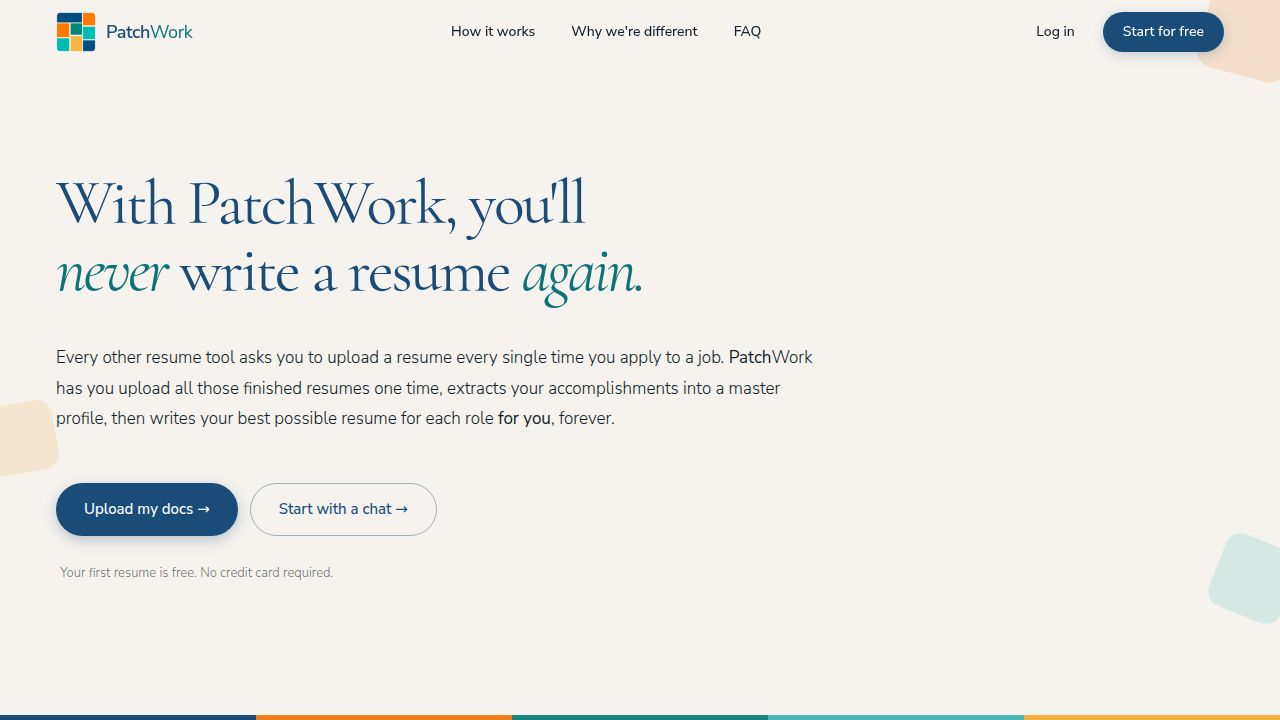
PatchWork
PatchWork - Resumes Built From Your Full Career History
PatchWork merges your old resumes and LinkedIn into one master profile, then generates tailored resumes for any job — without inventing a single word.
Smart angle. The flip side of this problem is on the employer end — we built jdintelligence.dev because most job posts are too messy/inconsistent for any tailoring tool (yours included) to parse reliably. Better structured JDs would make tools like this way more accurate.
jdintelligence.dev
JD Intelligence — Job Description API
Parse, score, enrich, and classify job descriptions with a single API call. 7-day free trial.
Excited to share this after 3 months of relentless building and shipping 🥳
Introducing PrepAlly - an AI mock interviewer that tries to replicate the real experience instead of just testing questions.
Why did I build PrepAlly?
Interviews are strange. You can spend weeks preparing, revise frameworks, rehearse answers in your head... and then the interviewer asks one unexpected follow-up and suddenly everything falls apart.
The truth is: most people don’t struggle because they lack skills. They struggle because they’ve never practiced interviewing in a realistic way.
That’s exactly why I built PrepAlly. It is designed to help you practice real interviews, anytime, anywhere.
Here’s what makes it different 👇
- 🎙️ Live AI voice interviews personalized to your resume, experience, and target role
- 🔗 Generate interviews from a job link - paste a job posting and PrepAlly builds a tailored interview around the role requirements
- 🧠 Dynamic interviewer personas that adapt to the job description - so a PM interview feels different from consulting, tech, finance, or MBA interviews
- 📄 AI-powered resume analysis to identify strengths, gaps, and areas you should be ready to defend in interviews
- 📈 Detailed feedback beyond just answers - confidence, communication, tone, delivery, vocabulary, and even posture/body-language analysis to help you improve how you present yourself, not just what you say
and more...
Whether you're preparing for internships, career switches, or aiming for top tech, consulting, finance, or leadership roles - PrepAlly helps you practice until confidence feels natural.
Try it free at prepally.app

PrepAlly
PrepAlly - Your AI-powered interview prep ally. Available 24/7.
PrepAlly is your AI-powered interview prep ally - available 24/7. Practice real interviews, get detailed feedback on your answers, tone, and confidence, and walk into every interview already knowing how it ends.
Cool idea. Curious how you handle prep when the job post itself is vague — we see this a lot on the JD side at jdintelligence.dev, half of postings have duties that contradict the title. Garbage JD in, garbage interview prep out probably applies here too.
jdintelligence.dev
JD Intelligence — Job Description API
Parse, score, enrich, and classify job descriptions with a single API call. 7-day free trial.
Traditional LMS platforms take forever set up and require dedicated teams to run, making them impractical to start-ups or companies without a dedicated L&D department. I intend to fix that with Mentorra; an onboarding platform that takes ten minutes to set up. You drop in your training materials, create roles, invite employees, and Mentorra automatically organizes your messy content into structured, bitesized modules. It's also got an AI assistant that can help answer common trainee questions so trainers don't have to repeat themselves over and over again.
The hope is to make onboarding less of a headache for start-ups and small companies.
I'll attach a link to the demo below. I'd really appreciate it if you guys could take a look and answer a few questions;
- does the value proposition make sense?
- what's missing?
- would you use this?
Thank you!
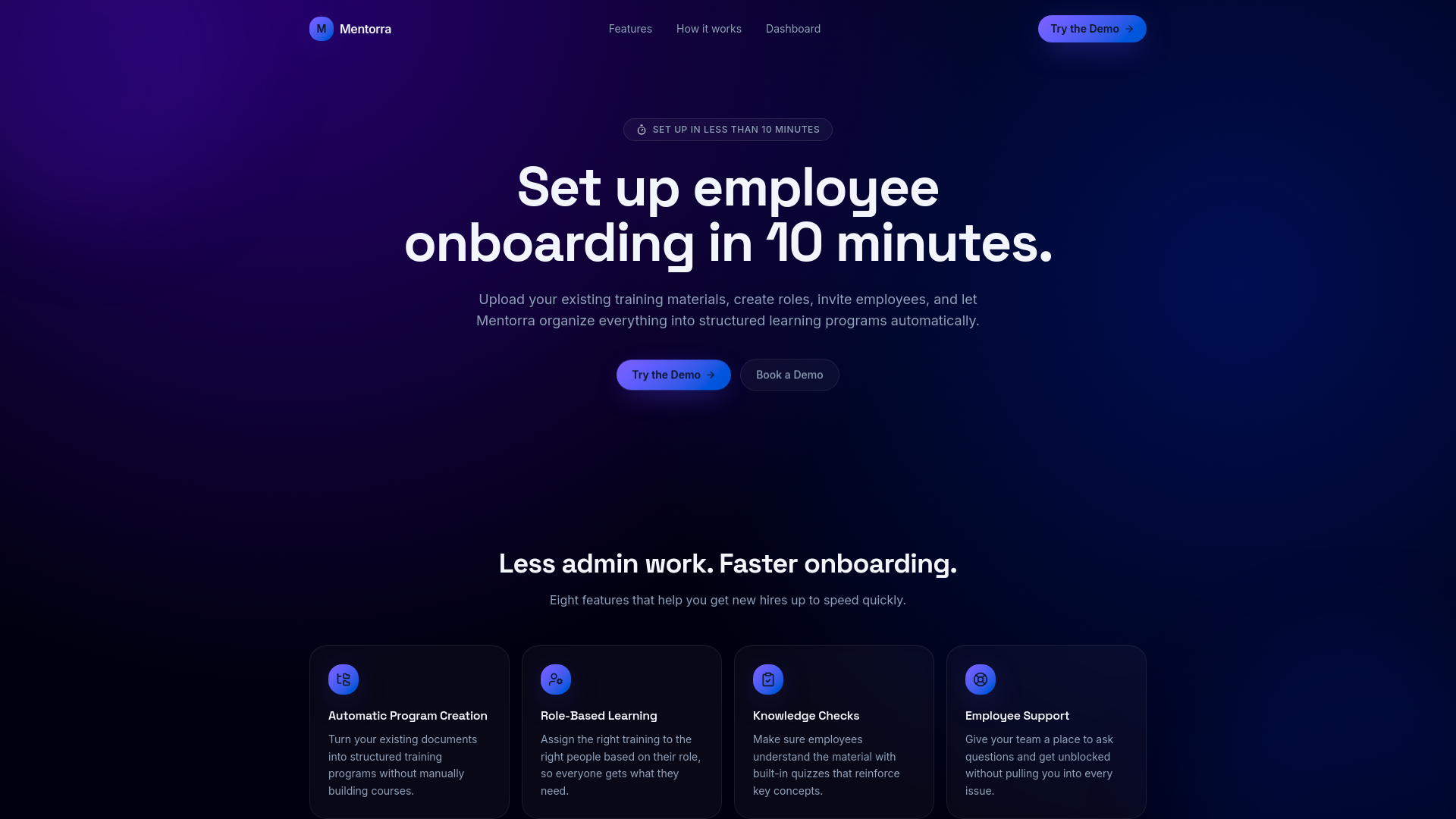
mentorra.lovable.app
Mentorra — Competency-Focused Training, Set Up in 10 Minutes
Levvel is a competency-focused training platform that reduces onboarding time and enhances employee development.
Onboarding speed matters once someone's hired, but the same fix is needed a step earlier. Most companies are still onboarding people into roles defined by a vague, copy-pasted JD, so day one starts with a mismatch nobody flagged. We built JD Intelligence (jdintelligence.dev) to clean that up before the role even gets posted.
jdintelligence.dev
JD Intelligence — Job Description API
Parse, score, enrich, and classify job descriptions with a single API call. 7-day free trial.

Building AI systems for the future of operations, automation, and autonomous workflows. Founder of OpsRadar. Learning relentlessly.
We are witnessing a bizarre double standard in enterprise AI.
When a company hires a fresh employee, they don’t hand them a laptop on day one and expect them to magically know the entire corporate strategy, past client wins, and internal pricing rules without training. They onboard them. They give them an internal handbook. They teach them.
Yet, executives are firing experienced humans, replacing them with a raw LLM API, and then getting angry when the agent hallucinates or fails.
AI isn't magic it’s trained on human experience. If you don't give your agents a dedicated, structured "Company Brain" to learn your specific business context, you haven't hired an automated workforce. You’ve just hired an army of interns with amnesia. Stop trying to automate your workflows until you build the infrastructure to actually train your agents.
Funny enough the same double standard exists one step earlier, before the AI or the employee even shows up. Companies spend weeks training a new hire but the job description that brought them in took 10 minutes and a copy-pasted template. We built JD Intelligence (jdintelligence.dev) because that gap upstream causes most of the matching headaches everyone blames on the AI layer.
jdintelligence.dev
JD Intelligence — Job Description API
Parse, score, enrich, and classify job descriptions with a single API call. 7-day free trial.
Experienced across sectors at the C-Suite level, got tired of the rat race and found the job hunt to be geared to support the recruiters more than the job hunters, working on a platform that levels the playing field.
I think I'm about 2 weeks out from shipping the Job Seeker portal of the TRAWLR product, giving candidates a better search, application management and preparatory tools for landing their next gig.
Once she's up and running I can fully focus on the Recruiter portal 🥂
The "truncated job descriptions need formatting work" line jumped out — that's the exact problem on the recruiter side too, just upstream. Most JDs aren't structured enough to score cleanly against in the first place, so matching engines on both sides end up compensating for messy source data. We built JD Intelligence (jdintelligence.dev) to clean that up before it hits any matching layer. Good luck with the recruiter side, that's the harder half.
jdintelligence.dev
JD Intelligence — Job Description API
Parse, score, enrich, and classify job descriptions with a single API call. 7-day free trial.
Oddit is a dev evaluation engine that turns a candidate's real shipped code into a 5-minute hire memo with file-and-line evidence and 11 work-pattern signals on how they actually engineer.
Hiring developers in 2026 has broken in a specific way. Candidates use AI to write their resumes. Engineers use AI to write the code they ship. Greenhouse's 2026 AI in Hiring Report (n=4,136) found 86% of recruiters caught or suspected candidate fraud last year, and 42% of candidates admit prompt-injecting their resumes. Meanwhile JetBrains' January 2026 survey of 10,000+ developers shows 90% use AI tools at work to write code.
So hiring teams have never had more evidence about a candidate, and never had less signal about whether the work is actually theirs or how they actually think. Bersin pegs the all-in cost of one bad senior engineering hire at $375k to $500k. Hiring managers are spending an hour or more reading each candidate's code and projects before a final-round call, guessing at what's AI-generated and what isn't, and still getting it wrong.
We solve this by auditing the candidate's actual code and producing a hire memo in 5 minutes. The memo classifies what they wrote (custom vs framework glue vs AI-assisted), cites file-and-line evidence for every claim, and surfaces 11 work-pattern signals (rationale habit, iteration discipline, decision quality, scope management, and 7 more) so the hiring team sees not just what they shipped but how they actually engineer.
Built and shipped the engine. Working multi-model audit pipeline in production: Code Property Graph analysis across 15+ languages via tree-sitter, 17 deterministic pattern detectors, a tool-calling verification agent that re-checks every claim against the actual code, and 11 person-level work-pattern signals across all of a developer's audited work. 153 audits run on real developer code since the May launch. 77 users signed up.
Oddit
Oddit | Prove Your Code. Build Your Credibility.
AI-powered platform to discover open source issues, verify your contributions, and build a verified developer portfolio.
This is a great way to fix the candidate-signal half of the problem. The other half is the JD itself — a hire memo this detailed doesn't mean much if the posting it's being matched against says "5+ years, rockstar, fast-paced environment" instead of an actual skill/seniority bar. We built JD Intelligence (jdintelligence.dev) for that side: structuring job descriptions so there's something precise to evaluate candidates against in the first place.
jdintelligence.dev
JD Intelligence — Job Description API
Parse, score, enrich, and classify job descriptions with a single API call. 7-day free trial.
Any non lazy hr here who would love to know about new tech for easy and reliable hiring
Worth checking out the actual job descriptions going into your pipeline too, not just the screening layer. We built JD Intelligence (jdintelligence.dev) because most "hiring tech" assumes the JD is already well-written, and most aren't. Garbage JD in, garbage matches out no matter how good the ATS is.
jdintelligence.dev
JD Intelligence — Job Description API
Parse, score, enrich, and classify job descriptions with a single API call. 7-day free trial.
most founders build for months before finding out nobody wanted it.
I almost did the same thing.
before I wrote a single line of code for my current project, I forced myself to answer one question: is there actually demand for this?
turns out that question is harder to answer than it sounds. surveys are biased. asking friends is useless. hiring a research firm costs more than your entire runway.
so I built a way to simulate it instead.
when a complete stranger — someone I've never met, never marketed to — signed up on their own, I knew I was onto something real.
that's the only validation that matters. not compliments. not 'looks cool bro'. a stranger taking action.
if you're pre-launch and still guessing whether your idea has legs — ScaleSim can tell you before you waste months finding out the hard way.
AI-powered market validation in one clean and simple report.
Spaceship
Buy way.ai | Spaceship
Own way.ai today. Secure checkout and guided transfer support. No hidden fees.
Same logic we're applying to a native app for our product. We keep getting asked for one, but instead of building it on a hunch we're treating demand as the gate — ship the web version first, build the app only if enough people actually ask for it. Saves months of work on the wrong thing.
Founder of SuRemote LLC. Connecting startups with remote talent, saving them up to 50K in hiring costs.
Hi everyone! My name is Guiseppe. Nice to meet all you fellow entrepeneurs 😄
Since this is my first post I'd like to start with something fun.
Share your business below and I'll give you an honest rating. Go!
All good, that's what it was like for me starting lol. Thanks for the feedback, and I wish I could find that demand, because wow, it's hard to find anyone willing to buy my service, genuinely don't know why. Thanks for the response though!
pgblame — CI guards your code and ignores your database. pgblame watches
Postgres query performance across deploys, so you see which deploy slowed a
query. $19/mo, real free tier. Looking for 2 design-partner beta users.
Backstory: I've had plenty of Postgres pain over the years, but the thing
that always nagged me wasn't one incident — it's that CI guards your code and
goes silent on your database. Deploys ship; nobody's watching whether they
slowed a query.
So I built the tool I wanted: pgblame. A tiny read-only Docker agent
snapshots pg_stat_statements every 60s, ingests your Vercel/Railway/GitHub-
Actions deploy webhooks, and shows "this query went 40ms → 800ms right after
this deploy." Same shape as Lantern but not Rails-only; ~1/8 the price of
pganalyze ($19/mo, real free tier). The agent runs in your env, read-only,
never sees your data, MIT-licensed.
It's live at pgblame.com but I haven't launched publicly yet — I want
2 founders running Postgres in prod (Supabase/Neon/RDS + Vercel/Railway,
shipping often) as design partners: 20-min call, you set it up while I watch,
brutally honest feedback, free Pro forever. Who's in?
pgblame.com
pgblame — which deploy slowed your Postgres?
A Docker sidecar that snapshots pg_stat_statements and ties query regressions to your Vercel/Railway deploys. $19/mo, free tier.
Love this — "CI guards your code and ignores your database" is such a sharp way to frame the gap. Tying query regressions directly to deploys is the kind of thing that should've existed years ago. $19/mo with a free tier is a great price point too — makes it an easy "just try it" decision. Following along, curious to see how the Supabase/Neon/RDS support holds up in the wild.
Job boards waste hours on bad JD data. Here's why — and how to fix it in one API call.
When an employer posts a job, they paste raw text. Your database gets a blob. No structured salary. No normalised skills. No seniority tag. Filtering and search end up useless.
I built JD Intelligence to fix this. One API call returns 16 structured fields from any raw job description: title, salary range, required skills, seniority level, remote policy, visa sponsorship, and more.
Also: /score (resume-to-JD matching), /enrich (rewrites JDs for clarity), /classify (department + seniority tagging).
$29/mo. 7-day free trial. Instant API key. No sales call.
Live demo — no signup: jdintelligence.dev/demo
Built for job boards, ATS tools, and recruiting agents. If you're building in this space I'd love to hear what you're working on.
call.live
This Domain is For Sale
No idea why it's pulling a link from call . live I own the link, so no clue why it would say I don't. If you plan to use the link, click on the one within the post.
Hello everyone, I built a job description API that can parse, score, enrich, and classify job descriptions with a single API call. Affinda charges $800/mo for JD parsing with a sales call requirement. I built the self-serve alternative starting at $29/mo with a 7-day free trial for a limited time.
Still in development, so there's more to come.
Demo page on the site, let me know your thoughts.
JD Intelligence — Job Description API
Will definitely consider that, will take note of it. Thank you for the offer. Currently, the product is small and in a startup phase, but as it progresses, as I hope it will, I will definitely be contacting you.